Picture a typical Monday morning: a 7th-grade teacher walks into class with 145 essays to grade, three differentiated lesson plans to prep, and a parent meeting at 4 PM. Meanwhile, half her students used ChatGPT over the weekend — some to outline ideas, some to write the entire paper. This is the world every K-12 educator is navigating right now, and it’s why the pros and cons of AI in classrooms have become one of the most urgent conversations in education. This article walks through the genuine benefits AI brings to K-12 learning, the real risks teachers need to watch for, the operational challenges schools face, and a practical framework for using AI responsibly.
What is AI in Education and How It is Used in K-12
AI in education refers to software that uses machine learning, natural language processing, and predictive algorithms to support teaching and learning. In a K-12 setting, this includes any tool that can adapt to a student’s responses, generate content, or analyze data faster than a teacher could by hand.
Today, AI shows up in K-12 schools through three main use cases:
- Learning tools — personalized learning apps that adjust difficulty in real time (e.g., Khanmigo, IXL adaptive paths, DreamBox).
- Chatbots — student-facing assistants that answer homework questions, summarize readings, or guide research at any hour of the day.
- Grading systems — automated assessment of objective questions, rubric-based scoring of essays, and feedback generation.
The Pros and Cons of AI in Education
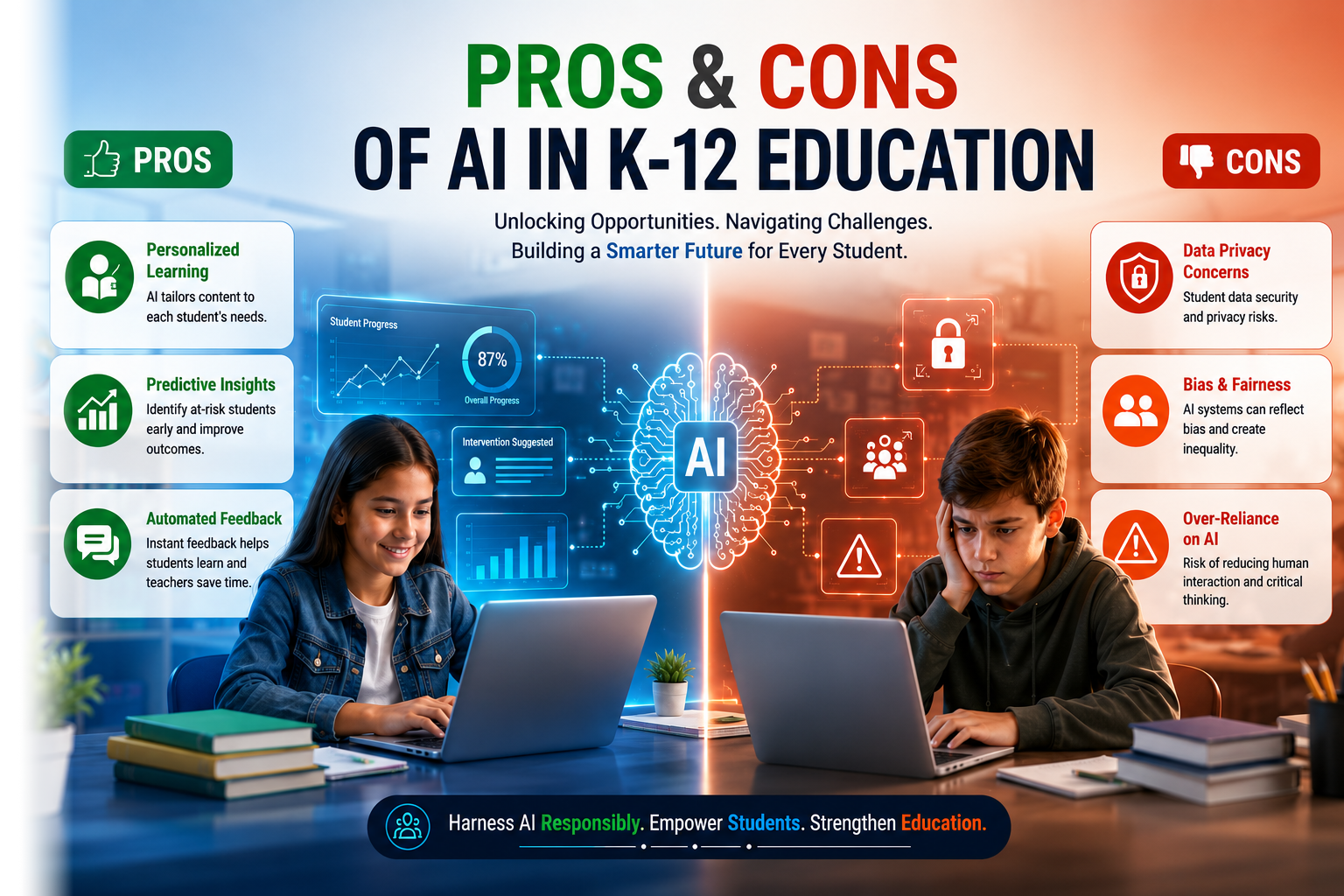
The honest answer to “AI in school: pros and cons?” is that both lists are real and growing. AI improves the learning experience in measurable ways — but it also creates new risks that didn’t exist five years ago. Here’s the side-by-side picture:
Pros at a glance
- Personalized learning at every student’s pace
- 24/7 support beyond classroom hours
- Time saved on grading and admin tasks
- Better accessibility for diverse learners
- Real-time data to spot at-risk students early
Cons at a glance
- Academic dishonesty and plagiarism
- Student data privacy & security risks
- Over-reliance reducing critical thinking
- Algorithm bias and incorrect answers
- Less human interaction in classrooms
- Digital divide and rising costs
Pros of AI in Education in K-12 Classrooms
AI helps both students and teachers in concrete ways. Here are the five most impactful benefits we see in pros and cons of AI in secondary education conversations across our partner districts:
Personalized Learning Experience
AI adapts to each student’s learning speed and skill profile — increasing difficulty when a student is mastering a concept and looping back when they’re struggling. This is a game-changer for weaker students who need more time but rarely get it in a traditional 30-student classroom.
24/7 Learning Support
Tools like AI tutoring chatbots provide help whenever students need it — late at night before a test, on weekends, during holidays. Students don’t have to wait until Monday morning to get unstuck on a math problem.
Saves Time for Teachers
AI automates time-consuming work like multiple-choice grading, generating assessment reports, drafting parent communications, and summarizing student progress. The minutes teachers reclaim go directly back into one-on-one student attention.
Better Accessibility for Students
AI dramatically improves accessibility for students with disabilities and English-language learners. Speech-to-text, text-to-speech, real-time translation, and on-the-fly reading-level adjustment help every student access the same content in the way that works best for them.
Data-Driven Insights
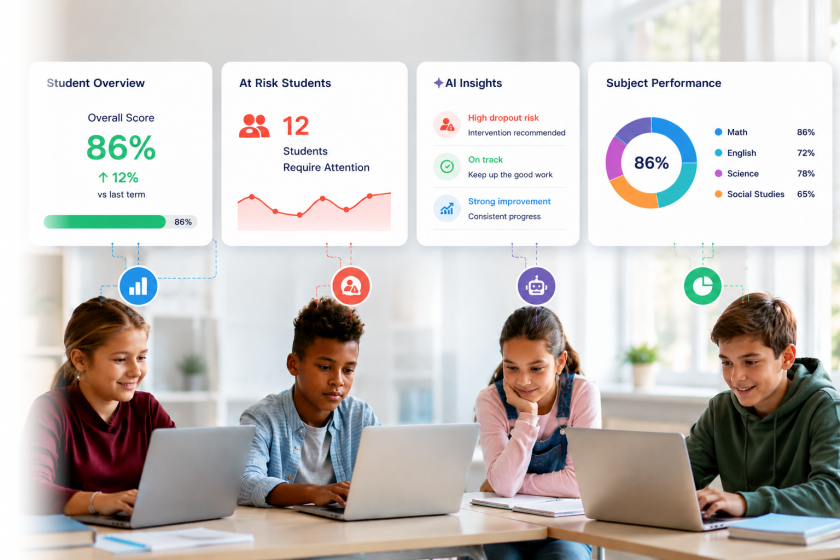
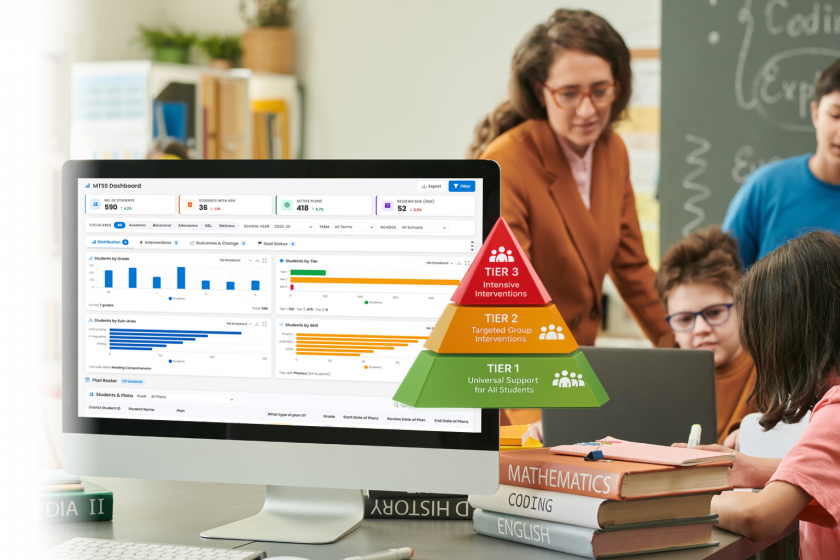
An AI-powered education insights platform helps schools identify learning gaps and at-risk students far earlier than human review alone. Predictive flags surface warning patterns weeks before grades or attendance reveal a problem.
Cons of AI in Education in Classrooms
The risks are just as real. Schools that adopt AI without addressing these concerns end up creating problems faster than they solve them.
Academic Dishonesty and Plagiarism
Students use AI to write entire essays, solve homework, and complete take-home assessments — making it harder to know whose work you’re actually grading. This has become one of the fastest-growing concerns in middle and high schools.
Data Privacy and Security Risks
Student data is highly sensitive, and many AI tools collect and process it in ways schools can’t fully audit. Risks of misuse, third-party data sharing, and breaches are major FERPA-level concerns districts have to address up front.
Over-Reliance on AI
When students lean on AI to do their thinking, the underlying skills — critical thinking, problem-solving, sustained reasoning — start to atrophy. The convenience of “ask the chatbot” can quietly replace the harder work of figuring it out.
Algorithm Bias and Errors
AI models can produce confidently wrong answers (“hallucinations”) and reflect biases baked into their training data. In an education context, that affects fairness — particularly when AI is used to grade, recommend interventions, or tier students.
Reduced Human Interaction
If students get most answers from a chatbot, teacher-student interaction drops. That impacts more than academics — relationships, mentorship, and social-emotional learning all happen through human connection that AI can’t replicate.
Digital Divide and Cost Issues
Premium AI tools are expensive, and not every district can afford them. Devices, broadband, licensing, and training costs add up — meaning AI can deepen inequality between well-funded and under-funded schools rather than narrow it.
| Dimension | What AI does well | What AI gets wrong |
|---|---|---|
| Instruction | Personalizes pace & difficulty | Can replace deeper teacher feedback |
| Assessment | Speeds up grading & reporting | Misses context, nuance, intent |
| Equity | Improves accessibility tools | Widens digital divide |
| Integrity | Generates examples & explanations | Enables plagiarism & shortcuts |
| Privacy | Centralizes data for insight | Introduces new vendor & breach risk |
Challenges Schools Face with AI — and How to Use It Responsibly
Even districts that want to adopt AI well run into the same operational hurdles. Here’s a practical breakdown of the challenges and the actionable practices that close the gap.
Challenges Schools Face
Lack of Teacher Training
Most teachers are still learning how AI tools work, what they’re good at, and where they fail — so adoption stalls or goes off the rails.
No Clear AI Policies
Schools often lack defined rules for what AI students and teachers can use, when, and for what — leading to inconsistent practice classroom to classroom.
Difficulty Tracking AI Usage
Hard to monitor how and where students use AI tools, especially outside school hours or on personal devices.
Managing Large Student Data
The volume of data AI tools generate quickly outpaces what most district teams can organize, secure, and act on.
How Schools Can Use AI Responsibly
Set Clear AI Usage Rules
Define what’s allowed and what’s not — for both students and staff — and put it in writing as part of the district’s acceptable use policy.
Train Teachers
Provide ongoing professional development on which AI tools to trust, how to detect AI-generated work, and how to integrate AI into instruction effectively.
Use AI as Support, Not Replacement
Position AI as an assistant that frees teachers to do more high-value work — never as a substitute for human judgment, mentorship, or relationship.
Monitor Student Usage
Track how AI is being used in learning. Build classroom routines that surface AI use openly so students learn to use it ethically rather than secretly.
The Future of AI in K-12 Education and Final Thoughts
AI is going to keep growing in K-12 classrooms. Within a few years it will be as common in lesson planning, grading, and personalized practice as the SIS is today for attendance. But the most successful schools won’t be the ones with the most AI — they’ll be the ones using AI most intentionally.
A balanced perspective is essential:
- Teachers will remain essential. Relationship, mentorship, and complex feedback are not jobs AI can do.
- AI is a support tool, not a replacement. Used well, it amplifies what great teachers already do.
- The best outcomes come when AI and teachers work together — AI handling the repetitive, teachers handling the human.
AI is powerful, but it also comes with real risks. Schools need a balanced and responsible approach to using AI — one that captures the upside while putting guardrails on the downside. The takeaway is straightforward: schools should focus on smart implementation.