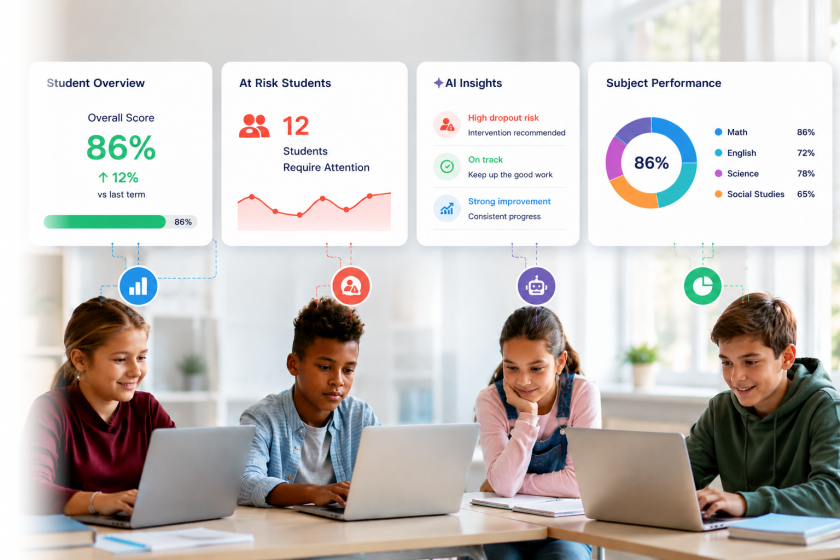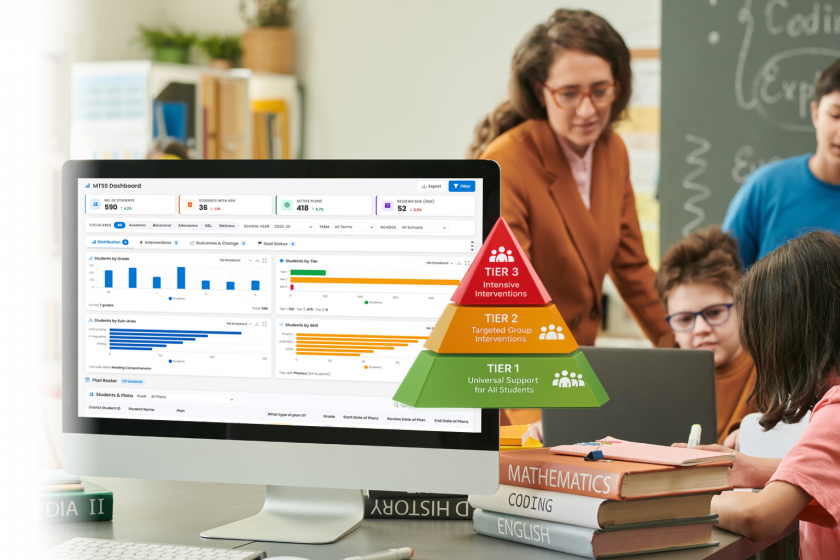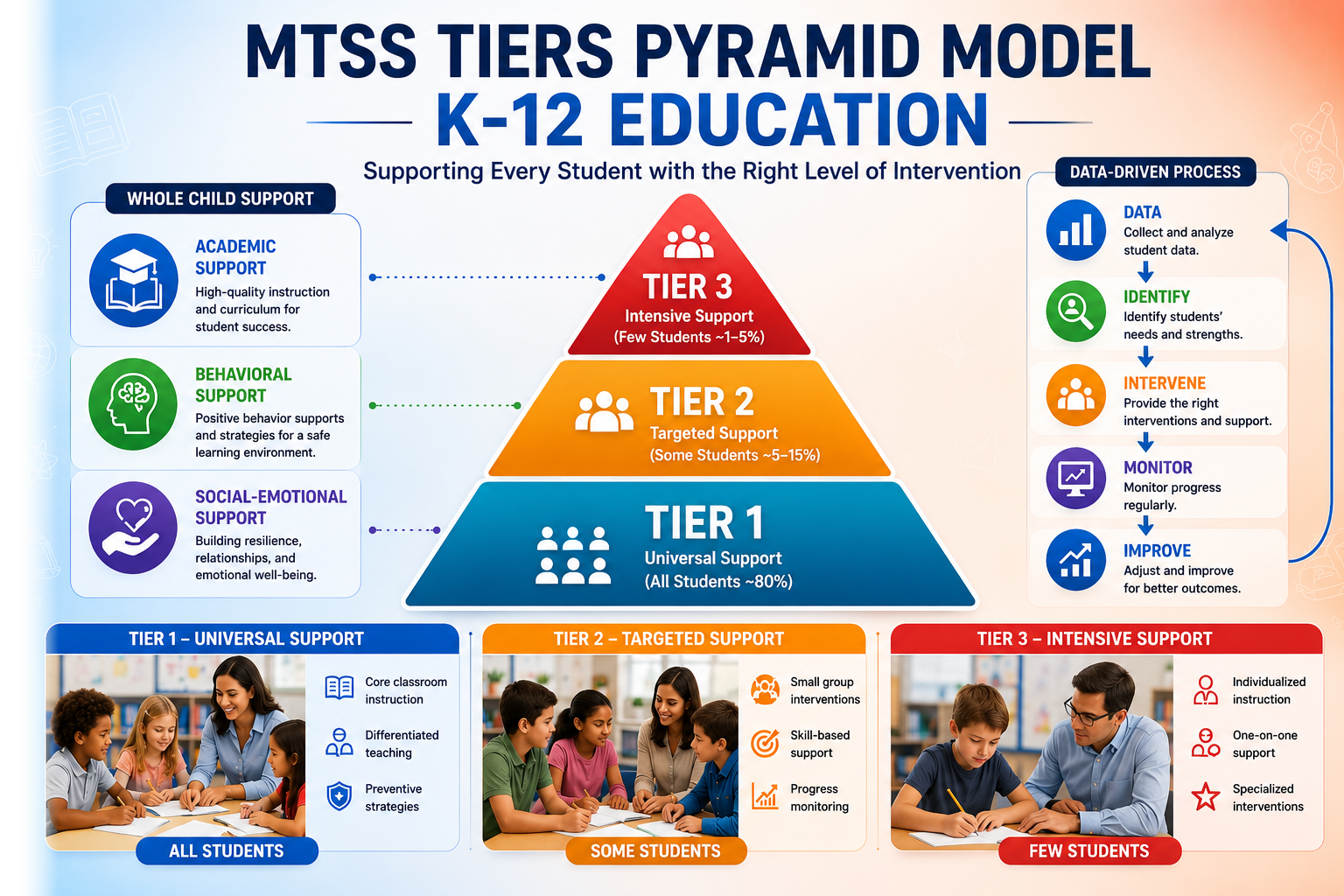
K-12 educators know the painful pattern: a student starts to slip, no one notices for weeks, and by the time interventions begin the gap is harder to close. The MTSS tiers framework solves that by creating a structured way to identify needs early and match support to severity. MTSS in school interventions isn’t a single program — it’s an integrated system that combines academic, behavioral, and social-emotional support guided by data. This article breaks down what MTSS is, explains the MTSS umbrella and how RTI & PBIS fit under it, walks through each of the MTSS tiers, and compares the traditional pyramid model with the newer MTSS diamond model.
What is MTSS in K-12 Interventions?
MTSS in school interventions is a unified, data-driven framework that delivers academic, behavioral, and social-emotional support to every student through layered tiers of intensity. It replaces the old “wait-to-fail” model with a proactive system that screens all students, monitors progress regularly, and adjusts support based on real evidence.
K-12 districts adopt MTSS because it answers three questions every school faces every day:
- Who needs more support? — universal screening identifies students before they fall behind.
- What kind of support? — tiered interventions match the right intensity to each student’s need.
- Is it working? — progress monitoring tells educators whether to continue, adjust, or escalate.
MTSS Umbrella: How Different Support Systems Work Together
The MTSS umbrella is the integrating concept that brings multiple support frameworks under one strategy. Two of the biggest are:
- RTI (Response to Intervention) — focuses primarily on academic support, using tiered instruction and progress monitoring.
- PBIS (Positive Behavioral Interventions and Supports) — focuses primarily on behavior support, building positive school-wide norms and targeted behavioral interventions.
MTSS sits over both, recognizing that academics, behavior, and social-emotional learning are deeply connected — a student rarely struggles in just one area.
MTSS Tiers and Pyramid Model Explained
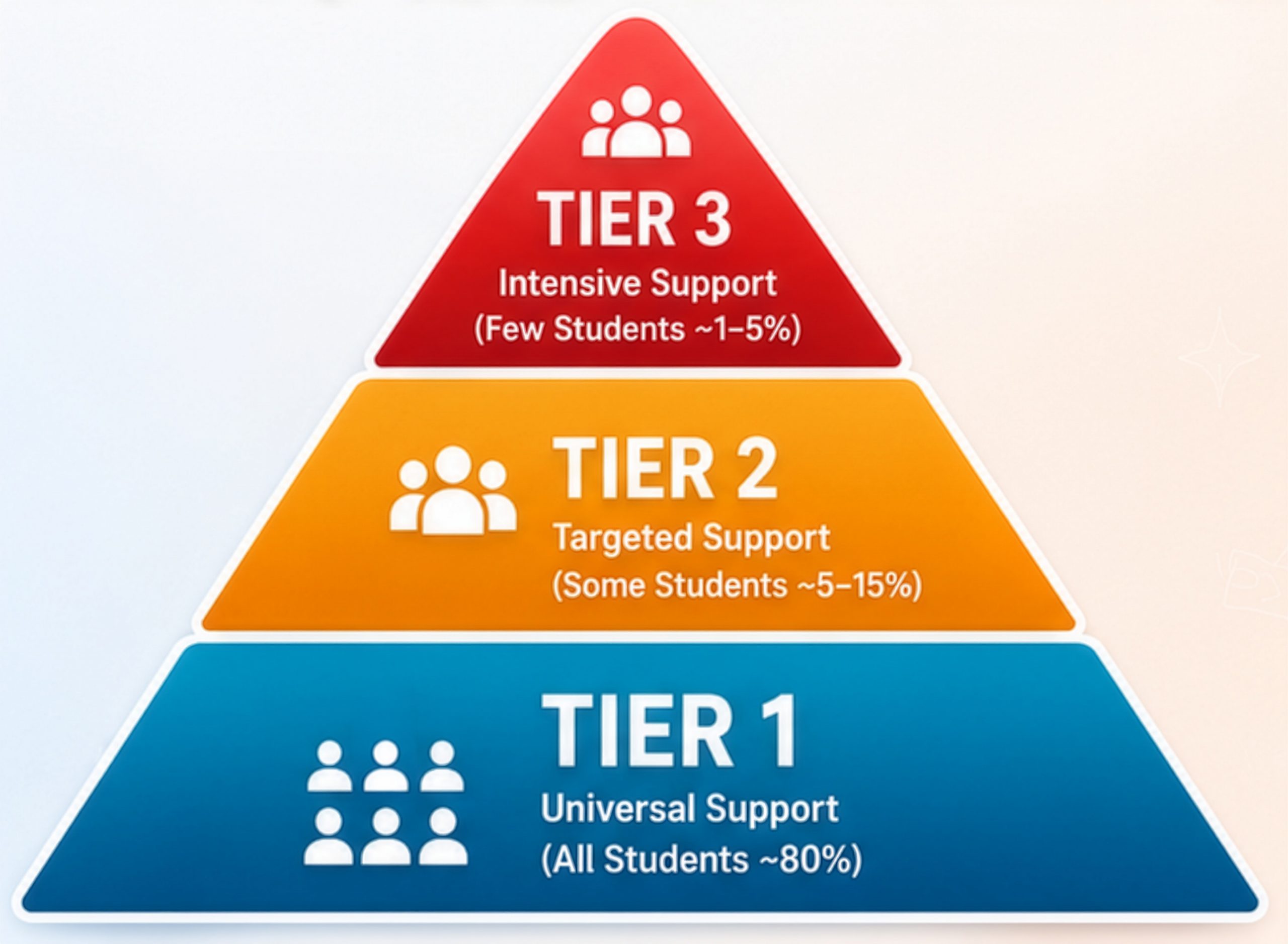
Most schools visualize MTSS as a three-tier pyramid — a wide universal base narrowing toward a small group of students with intensive needs. Here’s what are the MTSS tiers in plain terms:
Tier 1 — Universal Support (All Students)
Tier 1 is high-quality, evidence-based instruction delivered to every student in every classroom. It includes core curriculum, school-wide behavior expectations, and universal screening 2–3 times per year. About 80% of students typically thrive with Tier 1 support alone.
Tier 2 — Targeted Interventions (Some Students)
Tier 2 provides targeted, small-group support for students who aren’t responding to Tier 1 alone. Examples include 30-minute small-group reading 3x/week or a Check-In/Check-Out behavior plan. Roughly 15% of students benefit from this added layer.
Tier 3 — Intensive Interventions (Few Students)
Tier 3 delivers individualized, intensive support for students with significant needs — often 1:1 daily intervention, specialized instruction, or coordinated wrap-around services. About 5% of students require this most intensive tier.
Universal
Core instruction, school-wide behavior expectations, universal screening.
Targeted
Small-group interventions, supplemental skills support, frequent monitoring.
Intensive
Individualized 1:1 interventions, specialized programs, wrap-around services.
Important: students aren’t permanently placed in a tier. MTSS is flexible — a student can move up a tier when they need more support, and down a tier when progress monitoring shows they no longer need it. The whole model is built on the idea that support should match current need, not last year’s labels.
MTSS Diamond Model vs Pyramid Model
The pyramid is the most familiar shape, but a growing number of districts are moving to the MTSS diamond model because it captures something the pyramid misses: gifted and advanced learners who also need targeted support — just to grow, not to catch up.
The diamond model expands the pyramid upward, adding tiers for students who need enrichment beyond grade level. It treats acceleration as a legitimate intervention need, not a “nice to have.”
| Aspect | Pyramid Model | Diamond Model |
|---|---|---|
| Focus | Support and intervention for struggling students | Both support and growth/enrichment for all students |
| Shape | Triangle widening at the base, narrowing at the top | Diamond — widest in the middle, with enrichment tiers above and intervention tiers below |
| Who is served | All students (with extra layers for those falling behind) | All students (including those needing enrichment or acceleration) |
| Best fit for | Districts beginning their MTSS journey | Districts with mature MTSS systems pursuing equity and excellence |
Examples of MTSS Interventions in K-12
MTSS isn’t just a framework — it’s a catalog of practical interventions. Examples fall into three buckets:
Academic Interventions
- Reading support — phonics groups, fluency drills, comprehension instruction (e.g., Lexia Core5, Read Naturally)
- Math support — fact fluency, conceptual scaffolding, small-group reteaching (e.g., Reflex Math, IXL)
- Small group learning — guided instruction in groups of 3–6 with targeted skill focus
Behavioral & Social-Emotional Interventions
- Check-In/Check-Out (CICO) — daily structured behavior monitoring with adult mentor
- Counseling — individual or small-group counseling for emotional regulation and coping
- Social skills groups — structured peer-group learning of self-awareness and relationship skills
General Support Strategies
- Peer learning — peer tutoring, partner reading, cross-grade buddy systems
- Parent involvement — home-school communication plans, family literacy nights
- Classroom adjustments — preferred seating, sensory breaks, extended time, scaffolded materials
Key Components of MTSS Interventions
Three components hold the MTSS framework together. Without all three, schools have a label, not a system.
Universal Screening
Every student is assessed 2–3 times per year using validated tools to identify those who may need additional support. No one is missed.
Progress Monitoring
Student performance is tracked over time at frequencies matched to tier (Tier 2 = bi-weekly; Tier 3 = weekly) to verify whether interventions are working.
Data-Driven Decisions
Teams use objective data — not gut feel — to decide whether to continue, intensify, change, or graduate a student’s intervention plan.
Challenges Schools Face in Implementing MTSS
MTSS works — but only when the operational pieces are in place. Here are the most common implementation hurdles districts hit:
- Data scattered across systems — assessments live in one tool, behavior in another, attendance in a third, leaving teams without a complete picture.
- Manual tracking in Excel and shared files — fragile spreadsheets that break under volume and rarely sync between team members.
- Hard to identify students early — by the time the data finally surfaces, the warning window has closed.
- No clear visibility of interventions — leaders can’t see who’s getting what support or whether it’s actually being delivered.
How Data Helps Improve MTSS Outcomes in K-12
Data is what turns MTSS from a framework on paper into an effective daily practice. Three capabilities matter most:
- Real-time data — spot student needs early and act before issues compound.
- Unified dashboards — bring academic, behavior, attendance, and intervention data into a single, role-based view.
- Tracking interventions — monitor what support is being provided, who’s delivering it, and whether it’s moving the needle.
Conclusion
MTSS is a structured, proactive approach to supporting every K-12 student — not just those struggling the most. The pyramid model organizes academic, behavioral, and social-emotional support into three tiers of increasing intensity, while the newer diamond model adds enrichment for advanced learners. What makes MTSS succeed isn’t the shape on the wall — it’s the quality of the data behind it. Schools that pair the framework with centralized, real-time data systems identify needs earlier, deliver the right intervention faster, and watch student outcomes improve. The takeaway is simple: structure plus data equals support that actually works.